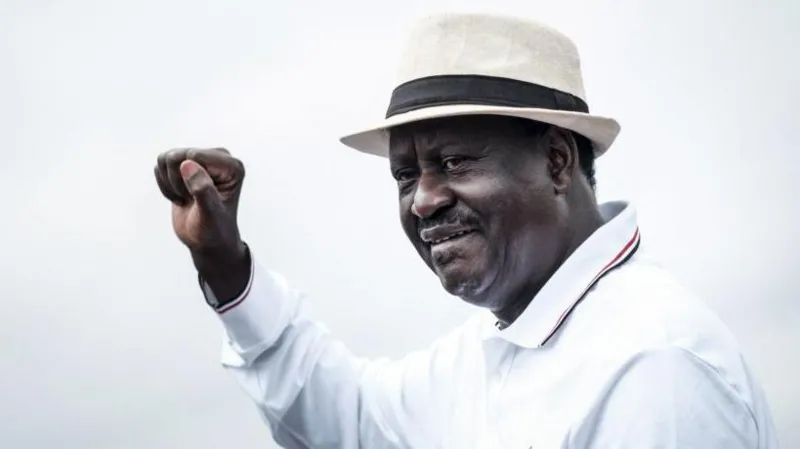
Few figures in Kenyan history have shaped the nation’s political landscape as profoundly as Raila Amollo Odinga. His passing at the age of 80 marks the end of an era—but also the beginning of reflection on a man whose influence outlived every election he lost.
For over four decades, Raila Odinga—fondly known as Baba—stood at the centre of Kenya’s democratic struggles, constitutional reforms, and power realignments. Though he never became president, his legacy towers over the republic’s post-independence history.
Born of Struggle, Raised in Resistance
Raila’s journey began on 7 January 1945, in Western Kenya. As the son of Jaramogi Oginga Odinga, Kenya’s first vice president and one of the fiercest anti-colonial leaders, politics ran in his blood. Yet from an early age, Raila learned that standing for the truth came with a price.
His father’s fallout with President Jomo Kenyatta in 1966 over unfulfilled promises of equity left the Odinga family politically isolated. But this isolation only strengthened Raila’s resolve. After studying in East Germany and returning home as an engineer and lecturer, he was drawn into Kenya’s turbulent politics—culminating in his detention over the 1982 coup attempt against Daniel arap Moi. He would spend nearly a decade behind bars, tortured yet unbroken.
The Reluctant Revolutionary
Upon his release, Raila became a central figure in Kenya’s pro-democracy movement. In the early 1990s, as Kenya returned to multiparty politics, Odinga emerged as a voice for the marginalized and a champion of justice. When Oginga Odinga passed away in 1994, Raila carried his father’s torch—founding his own party and contesting the presidency multiple times.
He ran for president in 1997, 2007, 2013, 2017, and 2022—each campaign defined by passionate crowds, fiery rhetoric, and promises of a fairer Kenya. The 2007 election, widely believed to have been rigged, sparked Kenya’s darkest political crisis. Yet it was Odinga who helped broker peace through a power-sharing deal, becoming Prime Minister under Mwai Kibaki in 2008.
The Constitution that Changed Keny
Raila Odinga’s most enduring legacy remains the 2010 Constitution—a document that redefined Kenyan governance. It devolved power to 47 counties, limited presidential authority, and enshrined civil rights in law. For Odinga, it was a dream realized after decades of resistance and advocacy.
“The fight was never about power for myself,” he once said. “It was about power for the people.”
This constitution, which he tirelessly campaigned for, continues to guide Kenya’s democracy today.
The Handshake and the Final Act
In 2018, after yet another disputed election, Odinga shocked the nation with a historic handshake with President Uhuru Kenyatta. It was framed as a gesture of national unity, but it divided opinion: admirers saw it as statesmanship; critics, as betrayal.
By the 2022 elections, Odinga—backed by Kenyatta—found himself in unfamiliar territory: aligned with the establishment he once fought against. When he lost to William Ruto, many wondered whether “Baba” had lost his revolutionary fire. Yet even in his later years, Odinga remained a political compass—guiding conversations about equity, justice, and reform.
His final political chapter came in 2025, when he agreed to support Ruto’s broad-based government amid growing youth-led protests. The move sparked debate: had the revolutionary become the reconciler? Or was he still, as ever, putting Kenya’s stability above his own ambitions?
A Legacy Etched in Kenya’s Soul
Raila Odinga’s story is not one of defeat, but of endurance. He was imprisoned, betrayed, and denied victory, yet he remained unwavering in his belief that Kenya could be better. He taught generations that leadership is not about titles, but impact.
His passing leaves a political vacuum few can fill. For President Ruto, it complicates the 2027 landscape. For Kenya’s opposition, it marks the loss of a unifying symbol. But for millions of ordinary Kenyans—from the markets of Kisumu to the hills of Kericho—Raila Odinga will forever be remembered as the man who changed Kenya without ever ruling it.